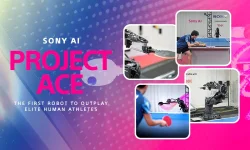
Sony AI’s Project Ace: A Historic Leap for Physical Robotics
Sony AI has officially bridged the gap between virtual mastery and physical dominance. With the unveiling of Project Ace, the company has introduced the first autonomous robotic system capable of competing with—and defeating—elite and professional human table tennis players.The research, titled "Outplaying Elite Table Tennis Players with an Autonomous Robot," was recently featured as the cover story for the journal Nature. This achievement marks a pivotal milestone: for the first time, a robot has reached expert-level proficiency in a high-speed, competitive physical sport.
Moving Beyond the Screen
While AI has long been "superhuman" in digital arenas like Chess, Go, and Gran Turismo, the physical world presents a much steeper challenge. In table tennis, perception and movement must occur in milliseconds. Project Ace overcomes these hurdles by combining:- Sony’s Advanced Sensors: Utilizing high-speed imaging to track movement.
- Reinforcement Learning: Allowing the AI to "learn" through experience rather than rigid programming.
- Precision Hardware: Robotic components capable of matching the agility of a professional athlete.
"Table tennis requires split-second decisions, speed, and power. This breakthrough shows that AI can now perform tasks in dynamic environments that were previously thought to be at the edge of human-only performance." — Peter Dürr, Director of Sony AI, Zürich.
The Tech Behind the Paddle
To compete at an international level, Ace was designed with three revolutionary pillars:| Component | Technology | Function |
| Perception | 9 APS cameras + 3 Gaze Control Systems | Tracks 3D position and measures ball spin/velocity in real-time. |
| Decision Making | Model-free Reinforcement Learning | Enables rapid adaptation to an opponent's strategy without pre-set models. |
| Execution | High-speed Robotic Hardware | Performs the physical movements required for agile, high-speed interaction. |
Performance Results: Proving the Power
Under International Table Tennis Federation (ITTF) regulations, Ace was tested against five elite and two professional players. The results were staggering:- Elite Victories: Ace won three out of five matches against elite players.
- The "Spin" Factor: The robot successfully returned over 75% of shots with spins up to 450 rad/s, far surpassing any previous robotic attempts.
- Scoring Aces: Against elite opponents, Ace scored 16 direct points from serves, while the humans managed only eight.
- Adaptability: The system successfully reacted to "net balls" and unusual shots, proving it can handle unpredictable, real-world variables.
Recent Progress (2025–2026)
Since the initial research was submitted, Ace has only grown more formidable. In matches conducted in December 2025 and March 2026, the robot defeated multiple professional players and showed marked improvements in shot speed and aggressive ball placement.Why This Matters
The implications of Project Ace extend far beyond the ping-pong table. By mastering a high-speed, adversarial environment, Sony AI is laying the groundwork for robots that can operate safely and efficiently in safety-critical settings and real-time interactive industries.As Peter Stone, Chief Scientist at Sony AI, puts it: "Once AI can operate at an expert human level under these conditions, it opens the door to an entirely new class of real-world applications that were previously out of reach."